
Introduction
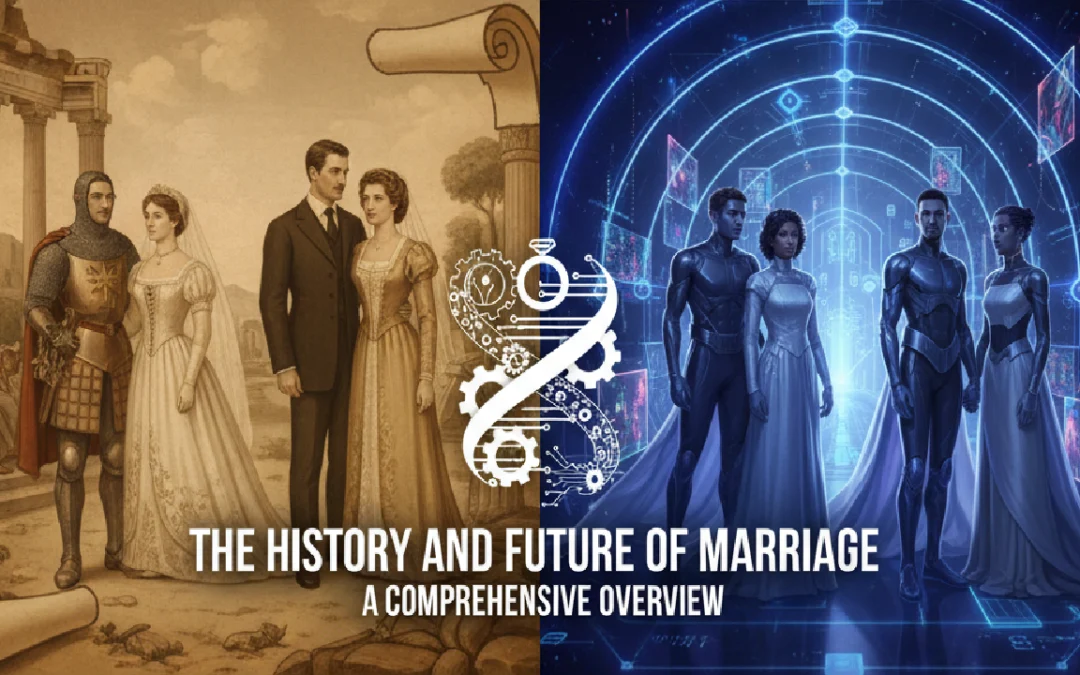
Marriage is one of humanity’s oldest social institutions, evolving over thousands of years to reflect the values, priorities, and dreams of society. In the West, it has transitioned from a tool for alliances and property consolidation to a deeply personal choice rooted in love, mutual respect, and companionship.
This article explores the rich history of marriage in Western civilizations, tracing its evolution from ancient practices to modern celebrations, and offers a hopeful, forward-looking vision of what marriage may look like in the future.
Marriage is more than a social contract—it’s a celebration of human connection, commitment, and joy. Understanding its past provides insight into its enduring relevance, while imagining its future allows us to see the possibilities for even more fulfilling partnerships.
I. Ancient Beginnings of Marriage in the West
1.1 Mesopotamia and Early Europe
In the earliest Western civilizations, including Mesopotamia and later Greece and Rome, marriage was primarily a strategic and economic institution. Around 2350 B.C., records from Mesopotamia show that marriages were arranged to consolidate property, form alliances, and secure family lineage. Romantic love was rarely a consideration; practical concerns dominated.
In Ancient Greece, marriage was a social obligation. Athenian women were primarily married to manage households and produce legitimate heirs. Wealthy families often used marriage to strengthen political or economic ties.
Rome added legal sophistication to the practice. Roman law distinguished between manus marriages, where a wife fell under her husband’s authority, and more flexible marriages where women retained property rights. Polygamy was rare, and marriage increasingly focused on family continuity and social stability.
1.2 Religion and Early Christian Influence
Religion played an increasingly important role in Western marriage. By the 4th century A.D., Christianity began influencing marriage practices, emphasizing its sanctity and permanence. By the Middle Ages, the Church formalized marriage as a sacrament, requiring public vows and witnesses.
Church influence also brought moral guidance: marriage was seen as both a spiritual and social duty. While medieval marriages were often arranged for property or social alliances, romantic love began to appear in literature and poetry, such as in the troubadour songs of 12th-century France, planting seeds for the idea of love-based unions.
1.3 Medieval Legal Frameworks
During the Middle Ages, European monarchies and city-states established legal codes regulating marriage. These laws included dowries, inheritance rights, and formal contracts. Public ceremonies and church recognition were crucial to make marriages legally binding.
Despite the practical focus, these frameworks laid the groundwork for modern marriage by recognizing the mutual obligations of partners, the legitimacy of children, and the societal importance of family alliances.
II. Renaissance to Enlightenment: Love Enters the Equation
2.1 The Renaissance and Cultural Shifts
The Renaissance (14th–17th centuries) ushered in a greater appreciation for individual expression and personal choice. Artistic and literary movements celebrated love, beauty, and emotional connection. While arranged marriages persisted among nobility for political reasons, the concept of marrying for affection gained popularity among the merchant and middle classes.
Romantic ideals were reflected in poetry, plays, and paintings. For instance, Shakespeare’s works often explored the tensions between duty, social expectation, and personal desire, highlighting love as a legitimate reason to marry.
2.2 Enlightenment Ideals
By the 18th century, Enlightenment thinkers championed individual rights and personal happiness. Philosophers like Jean-Jacques Rousseau argued that love and mutual respect should form the basis of marriage.
This period marked a turning point in Western marriage: the notion of love as a central reason for marriage gained cultural acceptance. Courtship rituals evolved, and marriages increasingly involved mutual consent rather than solely family arrangements.
III. Legal and Social Transformations
3.1 19th-Century Reforms
The 19th century brought significant legal changes in Western countries, empowering women and redefining marriage. Property laws gradually allowed married women to own and control assets. Divorce laws became more accessible, although still limited, allowing individuals to leave harmful or unhappy unions.
These reforms fostered marriages based more on partnership than obligation. Couples could now envision a life together built on mutual support, respect, and shared goals.
3.2 The 20th Century: Modern Marriage Takes Shape
The 20th century saw revolutionary changes. Love became the dominant motivation for marriage, legal frameworks promoted equality, and societal norms gradually recognized individual choice as paramount.
- Women’s Rights: Women gained legal autonomy, employment opportunities, and reproductive rights, reshaping marital dynamics.
- Civil Rights and Social Change: The post-war era and civil rights movements expanded acceptance of interracial and intercultural marriages.
- Same-Sex Marriage: The early 21st century marked a landmark moment when the Netherlands legalized same-sex marriage in 2001, paving the way for broader inclusion in Western societies.
Marriage, once a duty or a strategy, had become a vehicle for personal fulfillment, partnership, and shared happiness.
IV. Contemporary Trends
4.1 Delayed and Intentional Marriages
Modern couples are marrying later, prioritizing education, career, and personal growth. This intentionality leads to more stable, resilient marriages, as partners enter relationships with clarity, maturity, and shared life goals.
4.2 Cohabitation and Pre-Marital Partnerships
Living together before marriage is common, serving as a testing ground for compatibility. Rather than undermining marriage, cohabitation can strengthen relationships by allowing partners to build habits, communication skills, and trust before formalizing their commitment.
4.3 Diversity in Family Structures
Blended families, child-free couples, and non-traditional arrangements reflect the evolving nature of Western marriage. Acceptance of diverse structures fosters inclusivity and celebrates love in all its forms.
V. The Future of Marriage: A Positive Outlook
5.1 Marriage as a Conscious Choice
Marriage is increasingly a choice made for love, companionship, and shared life goals. This intentionality leads to stronger, more fulfilling partnerships built on communication, trust, and mutual support.
5.2 Technology as a Connector
Far from threatening relationships, technology enhances connection. Dating apps, virtual communication tools, and online counseling platforms allow couples to meet, bond, and maintain closeness in creative ways. AI tools may even assist with conflict resolution and communication, helping partners strengthen their relationships.
5.3 Egalitarian Partnerships
The trend toward equality in households and parenting continues to grow. Couples share responsibilities, finances, and childcare, creating a partnership that empowers both individuals and promotes lifelong satisfaction.
5.4 Expanding Inclusivity
Western societies are increasingly recognizing diverse forms of love. Same-sex marriages, blended families, and alternative partnerships are celebrated, reflecting the idea that marriage is about commitment and joy rather than fitting a rigid mold.
5.5 Lifelong Growth and Happiness
Marriage is becoming a space for personal and relational growth. Couples focus on communication, emotional intelligence, and shared experiences, ensuring that marriages evolve, flourish, and provide enduring happiness.
VI. Conclusion: A Thriving Future
From its early roots as a strategic alliance to its modern expression as a partnership based on love, equality, and intentionality, marriage has continually adapted to meet society’s needs. The Western tradition shows that marriage is resilient, evolving, and increasingly inclusive.
The future of marriage is bright. Couples are approaching marriage with purpose, creativity, and optimism. Technological innovations, egalitarian practices, and societal acceptance of diverse family structures promise partnerships that are more fulfilling than ever before.
Marriage remains a celebration of human connection—a source of joy, support, and companionship. The best is yet to come, and as society continues to evolve, marriage will continue to thrive, adapt, and inspire future generations to build strong, loving, and meaningful relationships.