
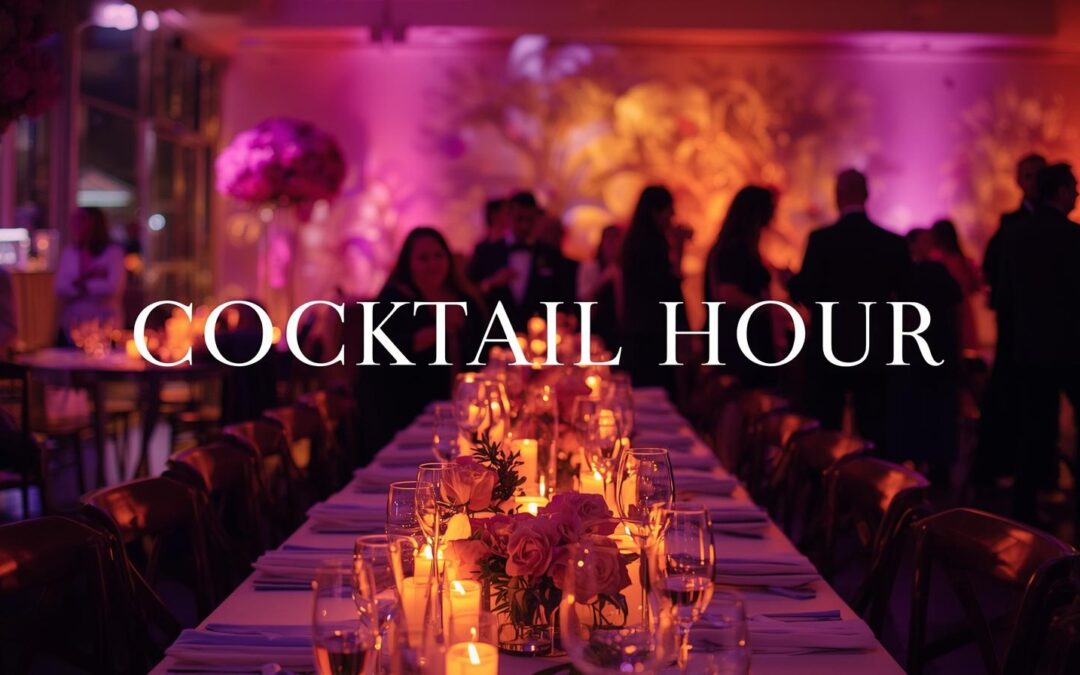
Cocktail hour at a wedding often feels like a sweet pause — a time when guests mingle, sip signature drinks, and soak in the excitement before the reception kicks off. But for many couples, this transitional moment can be overlooked or under‑curated. As a wedding DJ who’s spun thousands of hours, I’m here to tell you: when done right, the cocktail hour is one of the most important parts of your celebration.
Here’s my guide — based on experience, stories, and proven strategies — for making your cocktail hour fun, musical, and perfectly in sync with the rest of your event.
1. Understand the Role of Cocktail Hour Music
1.1 Ambiance, Not a Show
First off, treat cocktail hour music as ambiance, not a performance. Its job is to support conversation, not demand center stage. According to wedding planning guides, the music should remain mellow and played at a low volume so it doesn’t overshadow guests mingling. WeddingWire+2Wedding Spot+2
If the music is too loud or intrusive, it competes with the social energy — that’s a fast way to put people off. As one DJ guide notes, you want a subtle backdrop that enhances, rather than dominates, the space. Gay Weddings Magazine
1.2 Building Anticipation
Cocktail hour is also a bridge — a sonic and emotional transition from ceremony to reception. The right music helps set the tone for the rest of the evening. According to planners, you can gently build energy over the hour, setting the stage for the main party. One Of A Kind Events
A well-crafted playlist or DJ set during cocktail hour is like the opening act: it doesn’t need to steal the spotlight, but it should hint at what’s to come.
1.3 Volume & Audio Balance
One practical technical note: volume matters. Too quiet, and the music fades into the background so much that it loses impact. Too loud, and it drowns out conversations or makes guests lean in uncomfortably. As one DJ entertainment company puts it, striking the right balance is key. Altitude DJ
A professional DJ will continuously monitor and adjust sound levels as the space fills, and as guests move around. This dynamic adjustment is part of the value of having a DJ (vs just a plug-in playlist).
2. Choose the Right Types of Music for Cocktail Hour
Here, I walk you through genres, song styles, and how to pick tracks that enhance conversation and mood.
2.1 Recommended Genres & Styles
Some genres are almost tailor-made for cocktail hour — they create warmth, sophistication, and timelessness without demanding that people stop chatting.
- Jazz (instrumental, smooth): Classic, elegant, and conversation-friendly. Big band or small combo both work. Gay Weddings Magazine+1
- Classical: Instrumental classical music brings a graceful, refined feel. Gay Weddings Magazine+1
- Soft Pop / Acoustic: Light pop or acoustic covers give a familiar feel while keeping things gentle.
- Soul / R&B (soft): Warm vocals, mellow rhythms, familiar but not overpowering.
- Indie Folk / Indie Pop: Great for modern weddings — a little unexpected, but very lovely and unobtrusive.
- Instrumental Covers: String quartet versions of modern songs, piano covers, or other arrangements strike a nice balance. Wedding-spot guides recommend Vitamin String Quartet covers, for example. Wedding Spot
2.2 Mixing Familiar & Fresh
One of my favorite strategies is to mix familiar crowd-pleasers with a few surprising tracks. This gives guests something they recognize — which helps them relax — while also adding moments of discovery.
My one-of-a-kind playlist advice: pick 10–15 “seed” songs that define your vibe (classic jazz, indie love songs, acoustic soft pop), then layer in another 20–30 that complement those. One Of A Kind Events
That way, you have a strong foundation but also enough variety to keep things interesting without jarring shifts.
2.3 Flow Over Hour
Structure your cocktail hour music thoughtfully:
- Start soft: Use mellow, warming tracks as guests begin to arrive.
- Groove in the middle: As guests settle in, you can bring in a slightly steadier rhythm — still chill, but with a touch more motion and engagement.
- End with a lift: Finish up the hour with a few more upbeat (yet still smooth) songs that help segue into the energy of the reception. This rise in energy feels intentional and exciting. One Of A Kind Events
This kind of pacing builds emotion in a natural way.
3. Practical DJ Tips From DJ iSizzle
Here’s how, as a working wedding DJ, I think about programming and executing cocktail hour music. If you hire me (or any pro DJ), these are the behind‑the-scenes moves I make to make your cocktail hour feel effortless.
3.1 Preparation & Planning
- Client Consultation: Early in the planning, I ask couples what vibe they want for cocktail hour. Do they want totally background? Slightly more engaged? Do they have “must-play” or “do-not-play” tracks?
- Song List & Requests: I encourage couples to build a “must,” “maybe,” and “no thanks” list. That way, I know their priorities but also have creative room.
- Backup Tracks: I always build buffer tracks — extra songs that I can pull in if the hour runs long. And I have “wildcards” (uplifting but still appropriate) that I can drop in if the energy dips.
- Soundcheck: Before guests arrive, I test audio levels in the cocktail area. Since DJ setups for cocktail hour may be separate from reception areas, I double-check coverage, volume, and speaker positioning.
3.2 Live Adjustments
- Monitor the Room: As guests come in and start mingling, I adjust volume and track selection in real time. If people are deep in conversation, I might pick more chill, instrumental songs. If there’s laughter or people seem energized, I’ll lean into groovier tunes.
- Transitions & Flow: Smooth transitions are crucial. I use tempo matching, key matching, and phrasing to move between tracks gracefully — no abrupt jumps that jar the mood.
- Announcements: Generally, I avoid making announcements during cocktail hour, unless necessary (like a toast or logistical note). Music remains the focus — not the MC spotlight.
3.3 Segue to Reception
One of the things I do really carefully is plan the transition from cocktail hour into reception. Because I’ve built the cocktail set to gradually rise in energy, I can drop in more upbeat, slightly more “dance-ready” tracks at the end, but still stay in the background. Then, as the reception begins, I’m ready to shift gears into the high-energy dance set.
4. Curating a Playlist (Even If You Don’t Have a DJ)
Maybe you’re not working with a DJ for cocktail hour — maybe you’re making a playlist yourself or using a streaming service. That’s totally fine. Here are my tips for building your own:
4.1 Start With a Template
Use professional or pre-made playlists as a starting point. Sites like Lakeside DJs have expertly curated Spotify lists for wedding cocktail hours. Lakeside DJs Other DJ-curated mixologists (like Music Mixologists) also publish a wide array of ambient and themed wedding cocktail hour playlists. The Wedding Music Mixologists
These can give you direction, then you can personalize them.
4.2 Choose Your Seed Songs
Pick 10–15 songs that set your desired mood. These are your foundation — the tracks that reflect your taste and the overall vibe you want to create. Use a mix of genres: maybe a few jazz standards, some soft pop, an indie cover, etc. One Of A Kind Events+1
4.3 Build Out With Variety
From there, expand your list with more songs in complementary styles:
- A few instrumental covers (like string quartet versions of pop hits)
- Classic jazz or swing
- Soft soul or R&B
- Light acoustic or indie pop
- Maybe a few modern covers, if it suits your style
Be careful about extremes: you don’t want songs that are too slow (which may feel like waiting) or too fast/high-energy (which competes with conversation). One Of A Kind Events
4.4 Arrange for Flow
When you order your playlist, think about how it will unfold over an hour:
- First 10 minutes: Gentle, welcoming
- Middle 30–40 minutes: Steady groove, familiar but interesting
- Final 10–15 minutes: Slight lift, momentum building toward reception
Also build in backup / overflow songs — if your cocktail hour runs long (which often happens), you’ll want flexibility. One Of A Kind Events
4.5 Test & Fine‑Tune
Before the wedding, play your playlist in a similar environment (if you can): maybe in your living room, or during a dinner party. Pay attention to transitions, energy shifts, and volume levels. Make adjustments. Your DJ (if you’re hiring one later) will appreciate a refined list; if it’s self-managed, you’ll feel more confident.
5. Understanding Guest Psychology: How Music Affects Conversation
To really do cocktail hour right, it helps to know a little about how people experience conversations when there’s music playing.
5.1 Lyrics vs. Instrumentals
Research has shown that music with lyrics can more significantly “mask” speech, making it harder for people to hear each other. arXiv That doesn’t mean you should avoid songs with vocals — but you should be thoughtful.
Instrumentals are a really safe bet for much of cocktail hour. They provide texture without competing with spoken words.
5.2 Complexity & Volume
Music that is overly complex, or has lots of competing elements, can draw cognitive attention. Similarly, if volume is too high, it forces guests to lean in or raise their voices, which feels unnatural.
So, as a DJ (or playlist creator), aim for songs that are:
- Harmonically pleasant
- Rhythmically smooth (not jarring)
- Mid-range in instrumentation — not a full wall of sound
- Played at a volume that allows conversation without shouting
6. Sample Song Ideas & Playlist Suggestions
To make things concrete, here are some song ideas, plus a sample cocktail hour playlist structure inspired by DJ iSizzle’s approach.
6.1 Song Suggestions by Genre
Here are some types of tracks to consider, based on common wedding cocktail hour favorites:
- Jazz / Swing / Standards: Big band tunes, Miles Davis, Louis Armstrong, Sinatra, etc. Gay Weddings Magazine+1
- Classical / Instrumental: Piano versions of pop songs, string quartet covers, soft classical pieces. Wedding Spot
- Soft Pop / Acoustic: “I’m Yours” by Jason Mraz WeddingWire, “Domino” (Van Morrison cover), etc.
- Soul / R&B: Motown classics, mellow modern soul, smooth R&B vocals.
- Indie / Modern: Indie love songs, modern acoustic covers, indie pop tunes.
- Instrumental Covers: Anything from Vitamin String Quartet, piano or guitar arrangements.
Some specific picks from experts:
- “Sway” by Michael Bublé – Latin-jazz feel, mellow and classy. WeddingWire
- “L‑O‑V‑E” by Nat King Cole – classic swing elegance. WeddingWire+1
- “Here Comes the Sun” (instrumental version) – peaceful, familiar. WeddingWire
- “Georgia on My Mind” by Ray Charles – soulful and comforting. WeddingWire
- “Fever” by Peggy Lee – smooth jazz with personality. Yeah Weddings
6.2 Sample 60‑Minute Playlist Structure
Here’s a mock 60-minute cocktail hour playlist (you can adjust based on timing):
- “Sway” – Michael Bublé
- “Here Comes the Sun” – instrumental / acoustic version
- “Georgia on My Mind” – Ray Charles
- “I’m Yours” – Jason Mraz (acoustic feel)
- “Domino” – Van Morrison (or a cover)
- “At Last” – Etta James
- “My Girl” – The Temptations
- “Love Song” – Rhye
- “How Sweet It Is (To Be Loved by You)” – Marvin Gaye
- “Home” – Edward Sharpe & The Magnetic Zeros
- “Beyond the Sea” – Bobby Darin
- “Fever” – Peggy Lee
- “L‑O‑V‑E” – Nat King Cole
- “Such Great Heights” – The Postal Service (soft or instrumental cover)
- “Lovely Day” – Bill Withers (to build a little warmth toward the reception)
This list starts soft, builds a bit, then closes on a warm, upbeat note to lead into your reception. Feel free to swap songs based on your taste, guest demographic, or wedding style.
7. Coordinating With Other Vendors & the Venue
The cocktail hour doesn’t happen in a vacuum — you’re likely working with caterers, lighting & decor teams, photographers, and possibly live musicians. Here’s how to coordinate so music supports the overall event flow.
7.1 Timing & Logistics
- Know your layout: Is cocktail hour in the same room as the reception, or somewhere separate? Will your DJ system need to be relocated or duplicated?
- Schedule overlap: If live musicians (like a string quartet) are playing during cocktail hour, talk to your DJ (or yourself) about how to integrate or transition. As some experts suggest, mixing live and curated music can elevate the experience. Mil Besos Weddings
- Sound Zones: Ensure sound levels are appropriate for where people are gathering (bars, lounge areas, food stations). Your DJ should walk the space during setup.
7.2 Lighting & Ambiance
Music pairs with lighting to set mood. As noted by event entertainment pros, soft ambient lighting, dimmed uplights, and warm spotlights enhance the sensory experience when paired with mellow background tracks. Altitude DJ
7.3 Communication With Vendors
- Coordinate with photographers: Photographers often use cocktail hour as prime time for candid moments. Let them know your music plan so they can schedule around quieter or busier moments.
- Caterers & staff movement: If appetizers are being passed or stations are mobile, the DJ (or playlist) should adapt to shifting traffic flows and energy.
- MC involvement: If your MC (DJ iSizzle-style) needs to make announcements (welcome toast, schedule notes), plan those in at lower-volume moments. But usually, the MC takes a backseat during cocktail hour — less is more.
8. Engaging Guests Musically Without Overwhelming
Here’s how to use music to entertain guests subtly, create connection, and set the stage — all without turning the cocktail hour into a mini dance party.
8.1 Surprise Elements
- Vinyl or Record Requests: One fun trick: bring vinyl records or a record crate, and let guests browse and request a few songs. Something as simple as this encourages interaction and becomes a conversation starter. A bride on Reddit described her DJ bringing vinyl for guests to pick from — it became a fun, nostalgic moment. Reddit
- Instrumental Covers of Guest Favorites: Including instrumental versions of well-known pop or classic songs gives people the comfort of recognition without the full distraction of lyrics.
8.2 Thematic Sound Moments
If your wedding has a theme (vintage, boho, modern, cultural), weave that into the cocktail hour music subtly:
- For a vintage or Gatsby-style wedding: lots of swing, big band, and jazz standards.
- For a boho / garden wedding: acoustic indie, modern folk, soft soul.
- For a modern / minimalist event: ambient electronic, chill lounge, instrumental covers.
- For a destination or culturally specific wedding: incorporate local or cultural music (instrumental Latin, bossa nova, world jazz) to reflect you as a couple.
8.3 Creating Transition Points
Use the last 10–15 minutes of cocktail hour to transition your music more energetically, signaling to guests that the reception is about to begin. That doesn’t mean full-on club hits, but slightly more movement in the rhythm and harmony can help shift the mood.
I often use a mini build-up — a few songs that lift just enough, then fade into the reception’s opening song or announcement. This feels intentional, not abrupt.
9. Common Mistakes & How to Avoid Them
Here are some pitfalls couples or DJs often run into — and how to steer clear.
9.1 Mistake: Too Much “Do-Not-Play” List
Some couples give DJs an overly restrictive “do-not-play” list. While it’s good to have boundaries, if the list is too long, it limits the DJ’s flexibility and ability to read the room. One experienced DJ online advised: “a few songs is fine, but handing over a huge genre ban list makes the music feel like an iPod, not a live-curated experience.” Reddit
9.2 Mistake: No Buffer Tracks
Cocktail hours rarely go exactly one hour. Weddings run on “wedding rhythm,” not a clock. If you don’t have extra songs ready, you may run out of music, or worse, loop tracks awkwardly. Build in buffer / overflow tracks.
9.3 Mistake: Ignoring Acoustic Reality
If your DJ is set up inside but the cocktail hour is outside (or vice versa), sound may not carry the way you think. It’s critical to test speaker placement, volume, and acoustics during setup.
9.4 Mistake: Volume Too High or Too Low
Get the sound right. Too loud: guests can’t talk. Too soft: music feels like an afterthought. Professional DJs will walk through the space during setup and make adjustments as guests arrive. Continuous monitoring is essential.
9.5 Mistake: Jarring Transitions
Switching from mellow jazz straight into high-energy dance music without a bridge feels disjointed. Build transitions gradually, matching tempo, energy, and key when possible.
10. Why Having a DJ (Like DJ iSizzle) Matters
You might be asking: why hire a DJ just for cocktail hour? Here’s why a pro makes a big difference.
- Real-time energy management: A DJ doesn’t just press play — they read the room and shift the music to match.
- Seamless transitions: DJs can fade tracks, match BPM/key, and make the musical flow feel natural.
- Technical backup: I bring extra gear, backup tracks, and know how to adjust volume on the fly.
- Cue for other moments: If there are announcements, toasts, or transitions to dinner, a DJ can sync music with MC moments smoothly.
- Professional experience: I’ve done this hundreds of times. I know what works, what flops, and how to keep the vibe both relaxed and meaningful.
11. Real-Life Stories & Lessons (From DJ iSizzle’s Experience)
To ground this advice, here are a few real stories (anonymized) and lessons from my DJ life.
11.1 The Garden Wedding That Needed a Mood Reset
At one outdoor garden wedding, the cocktail hour started with very soft acoustic guitar, but as more guests arrived, the mood felt flat — people weren’t mingling much. I noticed during the first 15 minutes and gradually switched to a mix of warm soul and instrumental covers. The energy picked up, guests smiled more, and conversations flowed.
Lesson: Be ready to read the room early. If things feel too mellow, you can gently lift energy without breaking the vibe.
11.2 The Vinyl Crate Surprise
At another wedding, I brought a small crate of vinyl records (classic Motown, vintage jazz, ’70s soul), and guests were welcome to flip through and pick a few. It ended up being a hit — people chatted about songs, shared memories, and it became an icebreaker.
Lesson: Interactive musical elements (even small ones) help build connection among guests.
11.3 The Long Cocktail Hour (Buffer Saved the Day)
One couple underestimated how much photo time they needed, so their cocktail hour stretched to nearly 90 minutes. I had built in buffer tracks (extra 20 minutes of mellow but slightly groovy music), so I just rolled into them seamlessly. Guests barely noticed, and the energy remained consistent.
Lesson: Always build buffer tracks. Timelines shift — music shouldn’t feel rushed or looped.
12. Final Checklist: Getting Your Cocktail Hour Music Right
Here’s a quick checklist to make sure you’ve covered all the bases:
- Define your vibe: mellow, warm, slightly lively?
- Provide your DJ (or yourself) with a song list: must-play, maybe-play, do-not-play.
- Build a playlist (or have DJ build one) with 10–15 seed songs + 20–30 complementary tracks.
- Structure the hour with intentional flow: start soft → steady groove → lift.
- Prepare buffer songs for time flexibility.
- Test sound levels & speaker placement (with DJ): make sure it’s loud enough to hear, but not too loud to talk.
- Communicate with other vendors (caterer, photographer, MC) about music plan.
- Consider adding interactive or surprising musical elements (vinyl crate, instrumentals, live musicians).
- Confirm how the transition into the reception will happen musically.
- Do a run-through (if self-managing) to refine pacing, transitions, and volume.
- Make sure your DJ (or playlist) is ready to adapt in real time.
13. Why This Matters to Your Wedding Day
Putting in thought and effort into your cocktail hour music isn’t just about filling time — it’s about shaping the emotional and social energy of your event. When guests walk into a space that feels intentional, warm, and thoughtfully curated, they engage more deeply. They laugh, talk, sip, and anticipate.
As a DJ, I’ve seen it transform many weddings: a cocktail hour that could have felt like a waiting room becomes a moment of connection, mood-setting, and energy buildup. That’s not just “filler” time — that’s a meaningful part of your wedding story.
14. Final Thoughts From DJ iSizzle
If there’s one bottom-line piece of advice I always share with couples, it’s this:
Don’t treat cocktail hour as an afterthought. It’s not just downtime. It’s a musical chapter in your wedding day. Give it the same care and intentionality as your ceremony and reception.
Whether you hire a DJ (like yours truly) or build a playlist, choose music that supports people talking, knowing, and celebrating. Keep it in the background, but let it breathe. Let it lift. Use it to tell the first part of your story — the part where guests arrive, connect, and feel the promise of the evening ahead.
Your cocktail hour can be one of the most memorable, warm, and well-curated moments of the whole day. Do it right, and people will talk about it long after the dance floor opens.